During Mrs. Burn first trip, in 1929, to the Belgian Congo to
visit her husband she fell in love with the native hunting dog and
kept several as pets in the bungalow. In 1930 Mrs. Burn returned to
England, bringing with her five chestnut Basenjis.
They were placed in quarantine. Mrs Burn feared that, being
non-European dogs, perhaps without natural immunity, they needed to
be inoculated against distemper. At the time, the Ministry of
Agriculture prohibited the use of live vaccine, only dead vaccine
could be used. This vaccine only conferred protection for six months.
Within eleven days after inoculation, first one, then two more
eleven days after the first and finally a fourth, all came down with
a virulent form of distemper. The fifth, pictured in the November
1933 and May 1935 The Field (see below), was given Major Dunkin's
protective serum and she did not contract distemper.
For three years, she was a much-loved pet. In the spring of
1933, Mrs. Burn returned from the Congo with a mate for her. Mrs.
Burn had managed to persuade a chief of the Feshis to part with a
male dog named Kiluba. After coming out of quarantine in November of
1933, he was mated with her. Unfortunately, she died three weeks
later from septicemia caused by an internal tear that occurred during
the mating.
Mrs. Burn returned to the Congo and in 1936 brought out a dog, Bongo,
and two bitches, Bokoto and Bereke.
These three became the first founders of the breed. While she was in
the Congo, Kiluba had been left at a boarding kennel. When Mrs. Burn
came back from the Congo, he did not seem to be feeling well and soon
died. A postmortem revealed an ulcer, which was possibly caused by a
fish bone.
Sources:
Olivia, B. 1933. The "Field" Distemper Vaccine.
The Field. no. 4029 (Nov. 4): 1157.
Olivia, B. 1935. The Dog of Ancient Egypt? The
Field. no. 4048 (May 18): 1251.
Tudor-Williams, V. 1954. Basenjis: the Barkless Dogs.
London: Watmoughs Ltd. 79 pp.
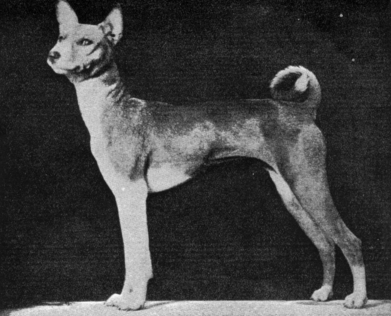
Mrs. Burn's imported bitch that did not get distemper.
Photo reproduced from the Field, November 4, 1933.